
概要
ミッドソールに3Dプリントされた特殊な構造が埋め込まれたアディダスのシューズ「4DFWD」は踏み込み力を推進力に変換する機能を持ちます。本記事ではこの機能を圧縮をせん断に変換するメカニカルメタマテリアルとして解釈し、その設計方法を解説します。
本記事は以下の3部構成のうち1つ目について解説します。
(2) 圧縮をせん断に変換するメカニカルメタマテリアルの設計
(3) 踏み込み力を推進力に変換するミッドソールの設計
4DFWD の機能解説
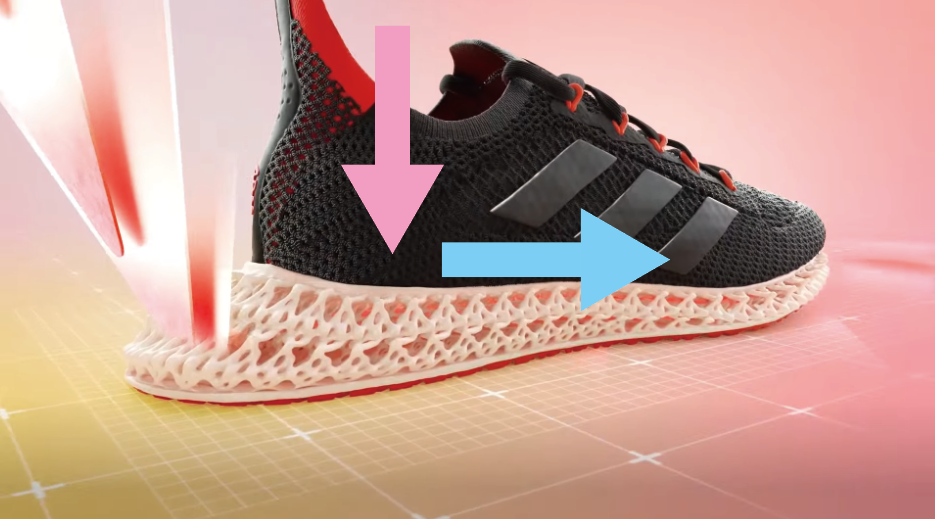
アディダスのシューズ「4DFWD」は踏み込み力を推進力に変換し、ランニング時のブレーキを抑制する効果を持ちます。この力の変換は3DPされたミッドソールのラティスと呼ばれる複雑形状によって実現されています。ラティスはユニットセルと呼ばれる単位構造がXYZ方向に繰り返される周期構造を持っており、このユニットセルが持つ弾性率などの力学特性をある種の材料特性とみなすことができます。ラティスの形状を工夫することで、通常の材料では実現できないような特性、例えばこのミッドソールにおいては踏み込み力を推進力に変換する特性、すなわち「圧縮をせん断に変換する」材料特性を設計することができます。このように幾何的形状によって特殊な材料物性が実現された材料を「メカニカルメタマテリアル (mechanical metamaterials)」と呼びます。
[引用:ADIDAS 4D FWD. Innovation in shock absorption! Spoiler: Hyperbola! (Youtube)]
ユニットセルの材料特性
それでは4DFWDのミッドソールが持つ「圧縮をせん断に変換」する材料特性とは何か?について解説します。
今回ミッドソールを真横からみることで、2次元の問題として考えます。
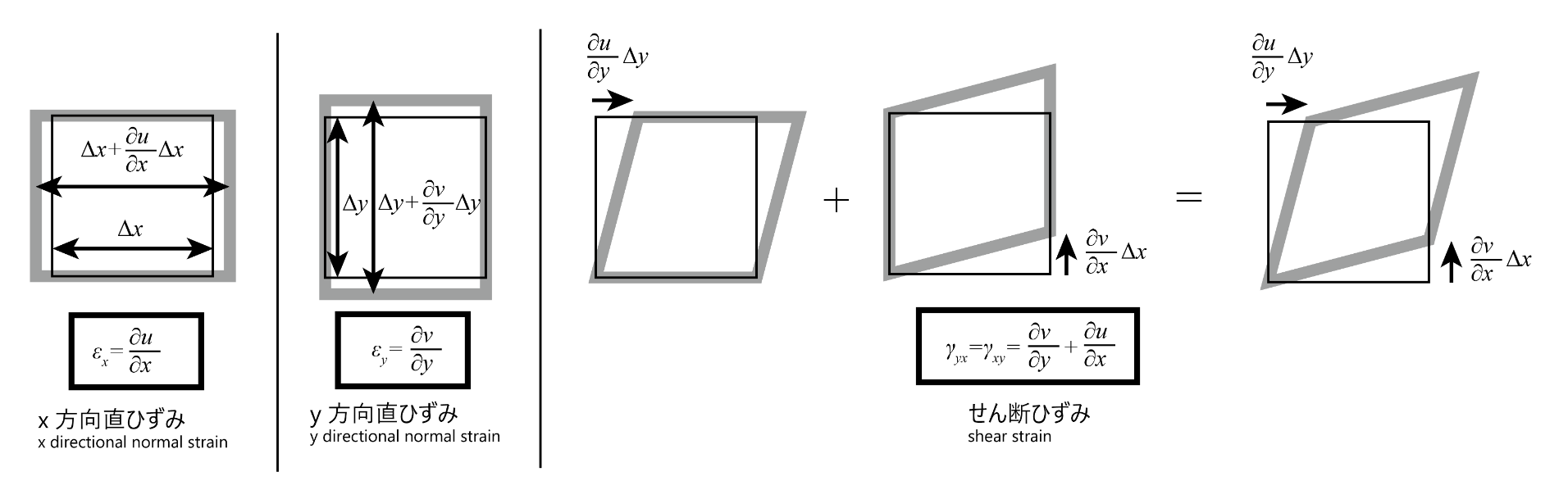
2次元の材料が変形する自由度は以下となります。
- \(\varepsilon_x\):X方向の伸びひずみ
- \(\varepsilon_y\):Y方向の伸びひずみ
- \(\gamma_{xy}=\gamma_{yx}\):せん断ひずみ
これらをまとめてひずみベクトル\(\boldsymbol\varepsilon = [\varepsilon_x, \varepsilon_y, \gamma_{xy}]^\mathrm{T}\)と表記します。
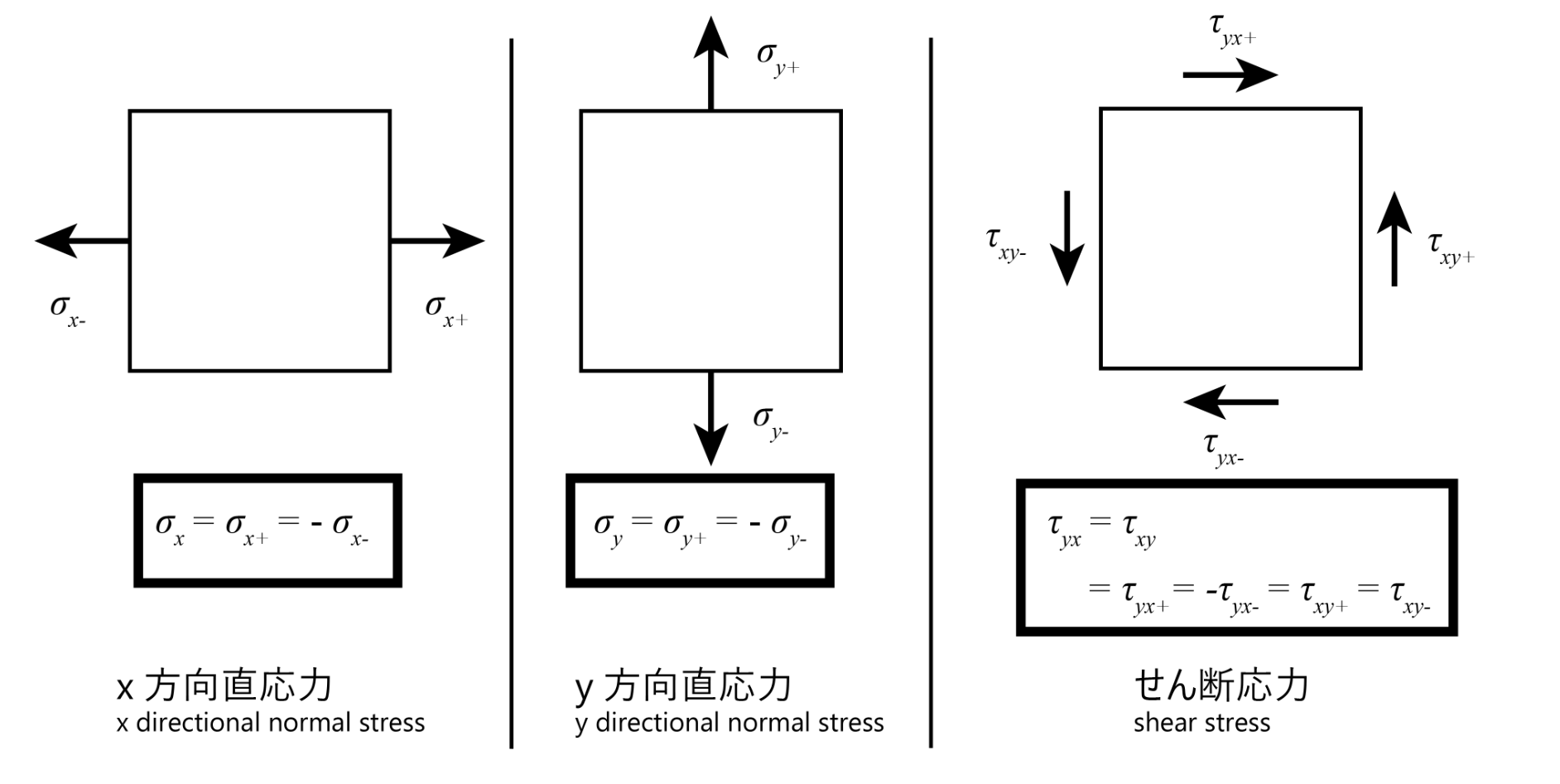
上記材料の変形に対応する応力は以下の3つです。
- \(\sigma_x\):X方向の引張応力
- \(\sigma_y\):Y方向の引張応力
- \(\tau_{xy}=\tau_{yx}\):せん断応力
これらをまとめて応力ベクトル\(\boldsymbol\sigma = [\sigma_x, \sigma_y, \tau_{xy}]^\mathrm{T}\)と表記します。
次に材料に応力が発生した時にどのようにひずむのか?という以下のような関係式を考えます。
\(\boldsymbol\varepsilon = \mathbf{S} \boldsymbol\sigma
\tag{1-1}\)
これは成分表示すると以下のようになります。
\(\left[
\begin{array}{c}
\varepsilon_x \\\\
\varepsilon_y \\\\
\gamma_{xy}
\end{array}
\right]
=\left[
\begin{array}{ccc}
S_{11} & S_{12} & S_{13} \\\\
S_{21} & S_{22} & S_{23} \\\\
S_{31} & S_{32} & S_{33}
\end{array}
\right]
\left[
\begin{array}{c}
\sigma_x \\\\
\sigma_y \\\\
\tau_{xy}
\end{array}
\right]
\tag{1-2}\)
この関係式を2次元線形弾性材料の構成則と呼び、行列\(\mathbf{S}\)をコンプライアンス行列と呼びます。
材料が均質に分布した等方性材料ではコンプライアンス行列はヤング率(縦弾性係数)\(E\)、せん断率(横弾性係数)\(G\)、ポアソン比\(\nu\)を用いて以下のように表されます。
\(\mathbf{S} =
\left[
\begin{array}{ccc}
\frac{1}{E} & -\frac{\nu}{E} & 0 \\\\
-\frac{\nu}{E} & \frac{1}{E} & 0 \\\\
0 & 0 & \frac{1}{G}
\end{array}
\right]
\tag{1-3}\)
等方性材料の場合、せん断率\(G\)はヤング率\(E\)とポアソン比\(\nu\)を用いて以下のように表されます。
\(G = \frac{E}{2(1+\nu)}
\tag{1-4}\)
圧縮がせん断に変換されることの材料力学的説明
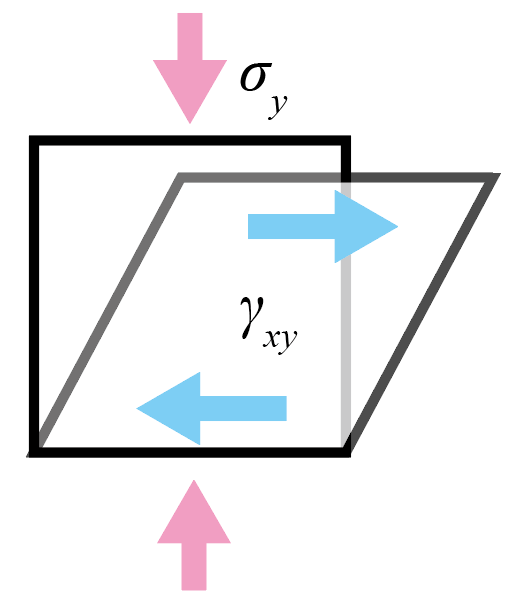
それではこの関係式上で圧縮がせん断に変換されるとはどういうことかを説明します。
上面に圧縮力を与えるということはY方向に応力\(-\sigma_y\)を与えることに対応します。
引張方向が正となっているので圧縮方向は負になることにご注意ください。
このとき応力ベクトルは\(\boldsymbol\sigma=[0, -\sigma_y, 0]^\mathrm{T}\)となり生じるせん断ひずみ\(\gamma_{xy}\)は式\(\text{(1-2)}\)より以下の式で表されます。
\(\gamma_{xy} = S_{32} (-\sigma_y)\tag{2-1}\)
したがって圧縮応力をせん断ひずみに変換するためには\(S_{32}\)が0でないような材料特性を設計する必要があります。
先程紹介した等方性材料の場合、\(S_{32}=0\)となるためせん断ひずみは発生しません。
それでは材料を回転させてみるとどうでしょうか?
材料を角度\(\theta\)回転させることはコンプライアンス行列に右から応力の変換行列\(\mathbf{T}_\sigma(\theta)\) 、左からひずみの変換行列\(\mathbf{T}_\varepsilon(\theta)\)の逆行列をかけることに対応し、新たなコンプライアンス行列を\(\mathbf{S}(\theta)\)とすると以下のようになります。
\(\mathbf{S}(\theta)=\mathbf{T}_{\varepsilon}(\theta)^\mathrm{-1}\mathbf{S}\mathbf{T}_{\sigma}(\theta)\tag{2-2}\)
ここで変換行列\(\mathbf{T}_{\sigma}(\theta)\), \(\mathbf{T}_{\varepsilon}(\theta)\)は以下であらわされます。
\(\begin{align}
\mathbf{T}_\sigma(\theta)&=
\left[
\begin{array}{ccc}
\cos^2{\theta} & \sin^2{\theta} & 2\cos{\theta}\sin{\theta} \\\\
\sin^2{\theta} & \cos^2{\theta} & -2\cos{\theta}\sin{\theta} \\\\
-\cos{\theta}\sin{\theta}  & \cos{\theta}\sin{\theta} & \cos^2{\theta} - \sin^2{\theta}
\end{array}
\right]\tag{2-3}\\
\mathbf{T}_\varepsilon(\theta)&=
\left[
\begin{array}{ccc}
\cos^2{\theta} & \sin^2{\theta} & \cos{\theta}\sin{\theta} \\\\
\sin^2{\theta} & \cos^2{\theta} & -\cos{\theta}\sin{\theta} \\\\
-2\cos{\theta}\sin{\theta}  & 2\cos{\theta}\sin{\theta} & \cos^2{\theta} - \sin^2{\theta}
\end{array}
\right]\tag{2-4}
\end{align}\)
これを計算すると圧縮応力をせん断ひずみに変換する\(S(\theta)_{32}\)は以下となります。
\(S(\theta)_{32} = \sin{4\theta}\cdot\frac{1}{4}\left(\frac{1}{G} - \frac{2(1+\nu)}{E}\right)\tag{2-5}\)
等方性材料の場合式\(\text{(1-4)}\)が成り立つので回転させても\(S(\theta)_{32}=0\)となります。
よって等方材料の場合圧縮応力をせん断ひずみに変換することはできないことがわかりました。
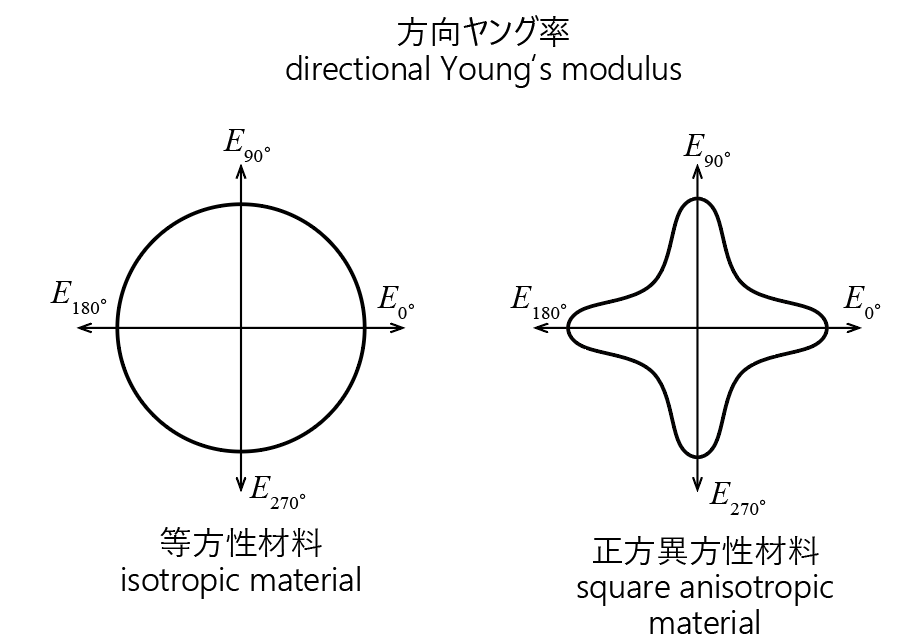
逆に式\((\text{1-4)}\)が成り立たない特殊な材料物性を設計することができれば、式\(\text{(2-5)}\)から\(S(\theta)_{32} \neq 0\)が成り立ち、圧縮応力をせん断ひずみに変換することが可能となります。このような線形弾性物性を持つ材料のクラスを正方異方性材料(square anisotropic material)と呼びます。
以下に等方性材料と正方異方性材料の回転角度毎の方向ヤング率(directional Young's modulus)を示しました。
等方性材料の場合、どの方向でも一定のヤング率を持ちますが、正方異方性材料は角度毎に異なるヤング率を示します。角度によって異なるヤング率を持つ材料を使うことで「圧縮応力をせん断ひずみに変換する」などの不思議な力学的現象を作り出すことができるのです。
まとめ
「圧縮がせん断に変換される」とはどういうことか?を材料力学を用いて説明しました。
等方性材料は上記特性を持たないことを示し、特殊な材料物性を持つ正方異方性材料が必要であることがわかりました。
次回、正方異方性物性を持つユニットセル構造を紹介し、具体的にどのような変形をするか解説します。
Overview
The adidas "4DFWD" shoe, which has a special 3D-printed structure embedded in the midsole, has the function of converting stepping force into propulsive force. This article interprets this function as a mechanical metamaterial that converts compression into shear and explains how to design it.
This article explains the first of the following three parts.
(1) Explanation of macro physical properties that convert compression to shear
(2) Design of mechanical metamaterials that convert compression to shear
(3) Designing a midsole that converts stepping force into propulsive force
Explanation of 4DFWD functions
The Adidas 4DFWD shoe converts the force of a step into propulsive force, which has the effect of inhibiting braking during running. This conversion of force is achieved by the complex shape of the 3DP midsole called Lattice. Lattice has a periodic structure in which unit structures called unit cells are repeated in the XYZ direction, and the elastic modulus and other mechanical properties of these unit cells can be regarded as a kind of material property. By devising the geometry of Lattice, it is possible to design material properties that cannot be realized with ordinary materials, for example, in the case of this midsole, the properties that convert the force of stepping into the shoe into propulsive force, or "compression into shear" material properties. Materials with special material properties achieved through geometry are called "mechanical metamaterials.
[citation: adidas Running's Youtube]
Material Properties of Unit Cell
So what are the material properties of 4DFWD's midsole that "convert compression to shear"? We will explain the material properties of 4DFWD's midsole that "convert compression to shear".
By looking at the midsole from the side, we will consider this as a two-dimensional problem.
The degrees of freedom for a 2-dimensional material to deform are as follows.
- \(\varepsilon_x\): elongation strain in the x-direction
- \(\varepsilon_y\): elongation strain in y-direction
- \(\gamma_{xy}=\gamma_{yx}\): shear strain
These are collectively denoted as the strain vector \(\boldsymbol\varepsilon = [\varepsilon_x, \varepsilon_y, \gamma_{xy}]^\mathrm{T}\).
The three stresses corresponding to the above material deformation are as follows.
- \(\sigma_x\): Tensile stress in x-direction
- \(\sigma_y\): tensile stress in the y-direction
- \(\tau_{xy}=\tau_{yx}\): shear stress
These are collectively denoted as the stress vector \(\boldsymbol\sigma = [\sigma_x, \sigma_y, \tau_{xy}]^\mathrm{T}\).
Next, how does the material twist when it is subjected to stress? We consider the following relational equation that says
\(\boldsymbol\varepsilon = \mathbf{S} \boldsymbol\sigma
\tag{1-1}\)
This would look like the following when displayed in component form.
\(\left[
\begin{array}{c}
\varepsilon_x \\\\
\varepsilon_y \\\\
\gamma_{xy}
\end{array}
\right]
=\left[
\begin{array}{ccc}
S_{11} & S_{12} & S_{13} \\\\
S_{21} & S_{22} & S_{23} \\\\
S_{31} & S_{32} & S_{33}
\end{array}
\right]
\left[
\begin{array}{c}
\sigma_x \\\\
\sigma_y \\\\
\tau_{xy}
\end{array}
\right]
\tag{1-2}\)
This relation is called the constitutive law for a two-dimensional linear elastic material, and the matrix \(\mathbf{S}\) is called the compliance matrix.
For isotropic materials with homogeneous material distribution, the compliance matrix is expressed using Young's modulus (longitudinal modulus) \(E\), shear modulus (transverse modulus) \(G\) and Poisson's ratio \(\nu\) as follows.
\(\mathbf{S} =
\left[
\begin{array}{ccc}
\frac{1}{E} & -\frac{\nu}{E} & 0 \\\\
-\frac{\nu}{E} & -\frac{1}{E} & 0 \\\\
0 & 0 & \frac{1}{G}
\end{array}
\right]
\tag{1-3}\)
For isotropic materials, the shear modulus \(G\) is expressed using Young's modulus \(E\) and Poisson's ratio \(\nu\) as follows.
\(G = \frac{E}{2(1+\nu)}
\tag{1-4}\)
Material mechanics explanation of the conversion of compression into shear
Let me explain what is meant by compression being converted to shear on this relational equation.
Applying a compressive force to the top surface corresponds to applying a stress \(-\sigma_y\) in the y-direction.
Note that the tensile direction is positive and the compressive direction is negative.
In this case, the stress vector is \(\boldsymbol\sigma=[0, -\sigma_y, 0]^\mathrm{T}\) and the resulting shear strain \(\gamma_{xy}\) is expressed by the following equation from \(\text{(1-2)}\).
\(\gamma_{xy} = S_{32} (-\sigma_y)\tag{2-1}\)
Therefore, in order to convert compressive stress into shear strain, material properties must be designed such that \(S_{32}\) is non-zero.
In the case of the isotropic material just described, \(S_{32}=0\), no shear strain is generated.
Now what if we rotate the material?
Rotating the material by an angle \(\theta\) corresponds to multiplying the compliance matrix by the inverse of the stress transformation matrix \(\mathbf{T}_\sigma(\theta)\) from the right and the strain transformation matrix \(\mathbf{T}_\varepsilon(\theta)\) from the left. Correspondingly, the new compliance matrix is \(\mathbf{S}(\theta)\) as follows.
\(\mathbf{S}(\theta)=\mathbf{T}_{\varepsilon}(\theta)^\mathrm{-1}\mathbf{S}\mathbf{T}_{\sigma}(\theta)\tag{2-2}\)
where the transformation matrices \(\mathbf{T}_{\sigma}(\theta)\) and \(\mathbf{T}_{\varepsilon}(\theta)\) are represented as follows.
\(\begin{align}
\mathbf{T}_\sigma(\theta)&=
\left[
\begin{array}{ccc}
\cos^2{\theta} & \sin^2{\theta} & 2\cos{\theta}\sin{\theta} \\\\
\sin^2{\theta} & \cos^2{\theta} & -2\cos{\theta}\sin{\theta} \\\\
-\cos{\theta}\sin{\theta}  & \cos{\theta}\sin{\theta} & \cos^2{\theta} - \sin^2{\theta}
\end{array}
\right]\tag{2-3}\\
\mathbf{T}_\varepsilon(\theta)&=
\left[
\begin{array}{ccc}
\cos^2{\theta} & \sin^2{\theta} & \cos{\theta}\sin{\theta} \\\\
\sin^2{\theta} & \cos^2{\theta} & -\cos{\theta}\sin{\theta} \\\\
-2\cos{\theta}\sin{\theta}  & 2\cos{\theta}\sin{\theta} & \cos^2{\theta} - \sin^2{\theta}
\end{array}
\right]\tag{2-4}
\end{align}\)
Calculating this, \(S(\theta)_{32}\), which converts compressive stress to shear strain, is as follows.
\(S(\theta)_{32} = \sin{4\theta}\cdot\frac{1}{4}\left(\frac{1}{G} - \frac{2(1+\nu)}{E}\right)\tag{2-5}\)
In the case of isotropic materials, the equation \(\text{(1-4)}\) holds, so \(S(\theta)_{32}=0\) after rotation.
Therefore, it is clear that compressive stress cannot be converted to shear strain in the case of isotropic materials.
On the other hand, if we can design special material properties for which the equation \((\text{1-4)}\) does not hold, then the equation \(S(\theta)_{32} \neq 0\) holds and compressive stress can be converted to shear strain. This class of materials with linear elastic properties is called square anisotropic materials.
Below are the directional Young's modulus for isotropic and square anisotropic materials at different angles of rotation.
Isotropic materials have a constant Young's modulus in all directions, while square anisotropic materials show different Young's modulus at different angles. By using materials with different Young's modulus at different angles, it is possible to create mysterious mechanical phenomena, such as "converting compressive stress into shear strain".
Summary
What does "compression is converted to shear" mean? was explained with the help of material mechanics.
We showed that isotropic materials do not have the above property and that square anisotropic materials with special material properties are necessary.
In the next issue, we will introduce unit cell structures with square anisotropic properties and explain how they are specifically deformed.
