
メタマテリアルとは何か?
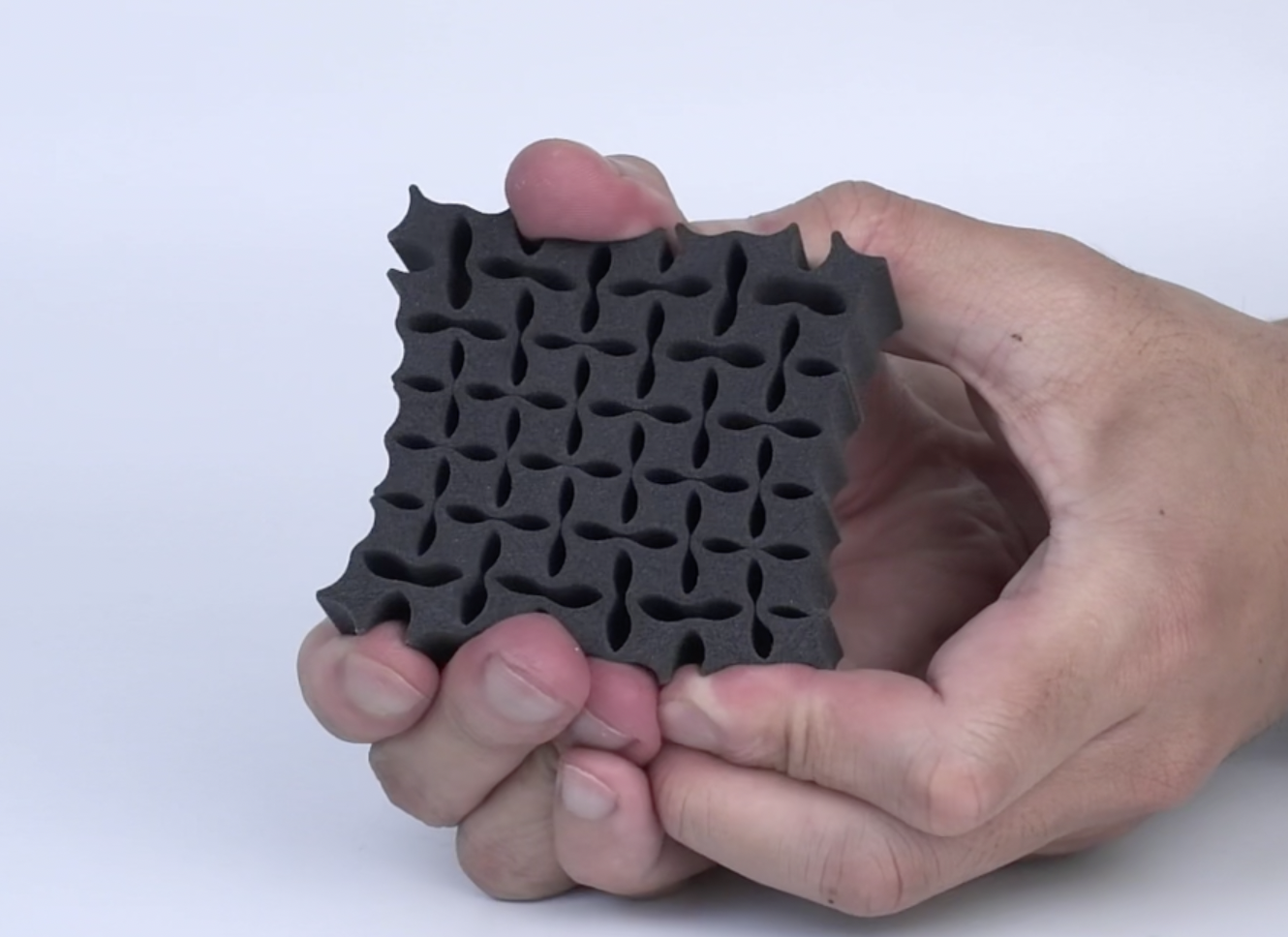
メタマテリアルとは何か?という定義の前にまず具体例を紹介します。この動画のメタマテリアルはゴムやエラストマーなどの一般的な柔軟な材料に穴をあけたシンプルな幾何構造ですが、特異な変形を生み出しています。一般的な柔軟材料は体積を保存するため圧縮方向と垂直な方向に膨らみます。一方で動画のメタマテリアルは圧縮方向に垂直な方向は膨らまずに縮み、全体として体積が拡大縮小する通常ではありえない変形が生まれています。こうした構造は負のポアソン比を持つメタマテリアル(Auxetic)と呼ばれています。
メタマテリアルという用語には様々な定義が存在しますが、弊社は最も広い意味での定義を採用しています。メタマテリアルとは特定の材料に人工的な幾何形状を設計する、または空間的に異素材を適切に配置して複合化させるなど、幾何構造や材料配置を適切に設計することで目的の”マクロな物性”がコントロールされたモノであり、その結果従来の物質の機能を凌駕するモノを指します。つまりすごく大雑把に言えばカタチの設計で新しい機能が生み出されたモノはメタマテリアルと考えることができます。動画のAuxetic構造は力学的メタマテリアル(Mechanical Metamaterials)のひとつだと言われています。
Auxetic構造は面白い変形をするだけではなく産業応用へのポテンシャルを秘めています。例えば、何かの対象物がAuxetic構造に触れた際に、ポアソン比が正のゴムやエラストマーなどの柔軟材料と比較してAuxetic構造は極端に大きな接地面積を生み出し「まるで対象物に吸着するような変形」を実現する高い追従性/圧力分散を実現する構造となっています。
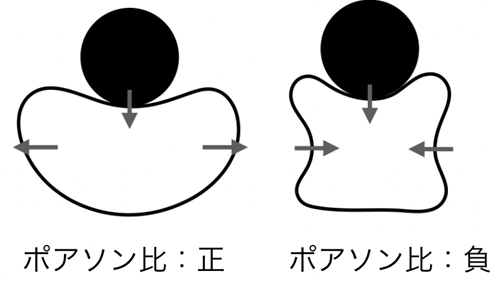
さらにこの構造は穴が空いているだけのシンプルな形状なので量産が可能です。したがって、この構造を寝具やオフィスチェアなどに組み込みめば体圧を大幅に分散する高機能な製品を生み出すことが(おそらく)可能です。
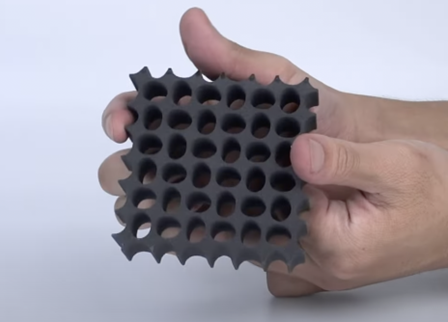
Auxetic構造は高い追従性/体圧分散以外にも衝撃吸収性、振動吸収性、音響遮断性に関しても従来の素材を超える性質を生み出すポテンシャルを持つと言われています。
負のポアソン比を持つ構造(Auxetic)が実際に現実的に動作する構造として発見されたのは1987年と比較的最近のことです1。さらに動画の穴を空けるだのシンプルな構造は2007年に初めて報告され、発見から20年も経過していません2。このAuxetic構造に限らずメタマテリアル全般の研究はまだ新しい研究領域であり、人類が経験したことのない新機能はまだまだ沢山存在すると思われます。
日常生活ではあまり意識することはありませんが、歴史を振り返れば新しい素材の発見/開発/普及で人類の営みは大きく変化してきました。例えば、ガラスの発見/普及がなければ、顕微鏡やメガネも存在せず科学や文化もここまで発展することはなかったでしょう。また、光ファイバー(ガラスの一種)がなければ高速インターネットも利用することがなかったかもしれません。ガラスはあまりにも偉大な事例ですが、メタマテリアルの一種だと考えることのできるハニカム構造もモビリティや航空宇宙産業で軽量で高い剛性を持つ壁面内部材として広く普及し我々の生活を陰で支えています。
私はNature Architectsにはメタマテリアルの設計を通して新しい機能を実現し普及させ、人類の営みをアップデートさせられると信じています。今後2~5年でみなさまに見せられる具体的な設計事例で大きなインパクトを出していこうと思っています。
引用
*1Lakes, R.S. (1987) Foam Structures with a Negative Poisson’s Ratio. Science, 235, 1038-1040.
*2 "Pattern Transformation Triggered by Deformation" September 2007Physical Review Letters 99(8):084301
What is Metamaterials
What is a metamaterial? Before defining what a metamaterial is, let us first introduce one example. The metamaterial in this video is a simple geometric structure of holes in a common flexible material such as rubber or elastomer, but it produces an unusual deformation.
On the other hand, the metamaterial in the video shrinks perpendicular to the direction of compression without expanding, creating an unusual deformation in which the overall volume expands and contracts. Such structures are called metamaterials with negative Poisson's ratios (auxetic).
There are many definitions of the term metamaterial, but we employ the broadest definition. Metamaterials are objects whose desired "macroscopic properties" are controlled by appropriately designing their geometric structure and material arrangement, such as by designing artificial geometries into specific materials or by compositing different materials in appropriate spatial arrangements, etc. As a result, they can surpass the functions of conventional materials. In other words, very broadly speaking, objects whose new functions are created by designing their shapes can be considered metamaterials. The Auxetic structure in the video is said to be one of the Mechanical Metamaterials.
Auxetic structures not only have interesting deformations, but also have the potential for industrial applications. For example, when an object touches the Auxetic structure, the Auxetic structure has an extremely large contact area compared to flexible materials such as rubber or elastomer with a positive Poisson's ratio, and the Auxetic structure has a high tracking/pressure dispersion that enables "deformation as if it were adsorbing the object.
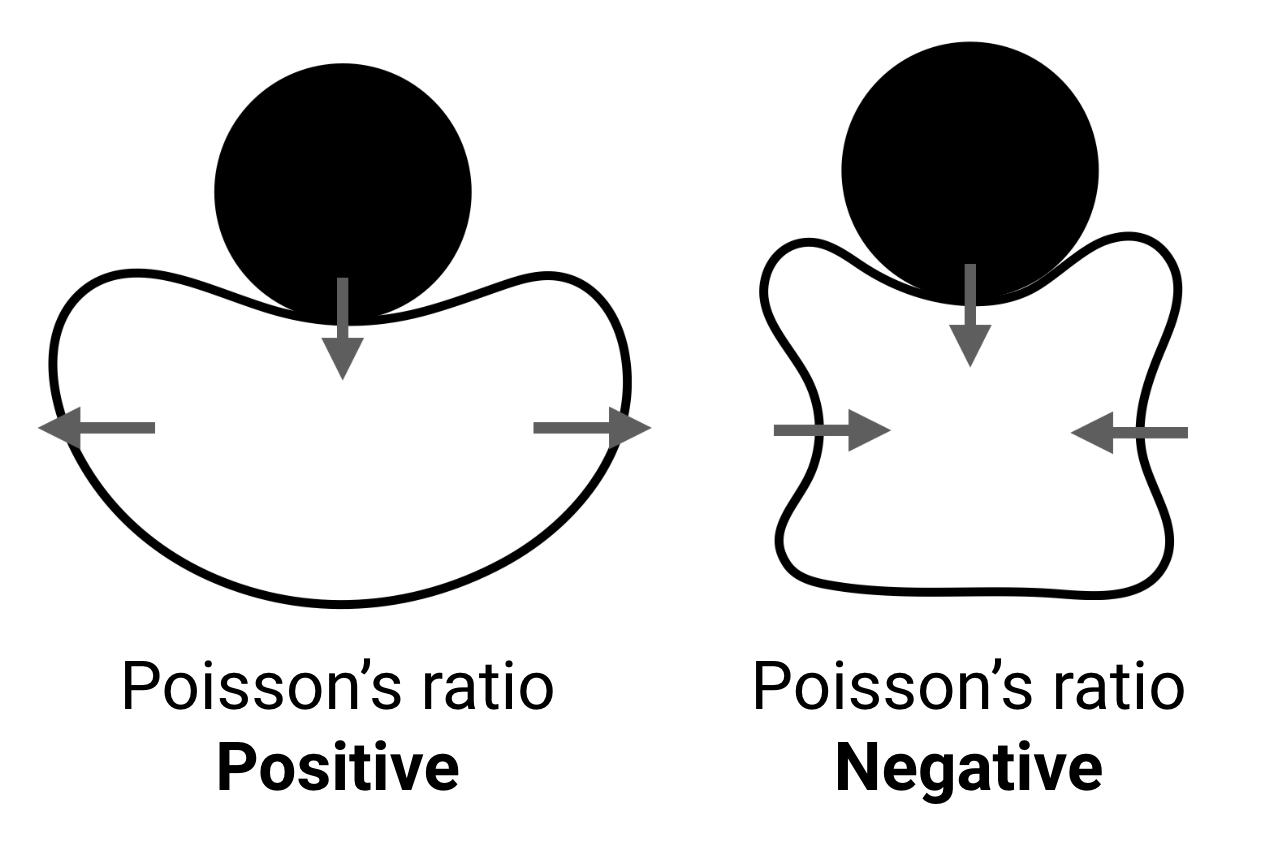
Furthermore, this structure has a simple geometry with only holes, so it can be mass-produced. Therefore, if this structure is incorporated into bedding, office chairs, etc., it is (probably) possible to create highly functional products that significantly disperse body pressure.
Auxetic structures are said to have the potential to produce properties that exceed those of conventional materials in terms of shock absorption, vibration absorption, and acoustic insulation, in addition to high tracking/pressure dispersion.
Auxetic structures with negative Poisson's ratios were first discovered in 19871, and a simple structure with holes in the video clip above was first reported in 2007, less than 20 years after its discovery2. The study of metamaterials, in general, is still a new field of research, and there are still many new functions that have never been experienced by humans.
Although we are not often aware of it in our daily lives, if we look back in history, the discovery/development/dissemination of new materials has greatly changed the activities of humankind. For example, without the discovery of glass, microscopes and glasses would not have existed, and science and culture would not have developed to this extent. Also, without optical fiber (a type of glass), we might not have had access to high-speed Internet. Glass is too great an example, but honeycomb structures, which is a type of metamaterial, are also widely used in the mobility and aerospace industries as lightweight, highly rigid in-wall components that support our lives behind the scenes.
I believe that Nature Architects has the ability to realize and spread new functions through metamaterials design, and to update human activities. We would like to make a big impact with concrete design examples that I can show you in the next 2~5 years.
Reference
*1Lakes, R.S. (1987) Foam Structures with a Negative Poisson’s Ratio. Science, 235, 1038-1040.
*2 "Pattern Transformation Triggered by Deformation" September 2007Physical Review Letters 99(8):084301
