
Legacy Benchmark
48
months
Traditional Global OEMs
Wolfsburg / Tokyo / Detroit
The pillar of competitiveness in automotive development has shifted ? not only to individual performance, but to development processes that can rapidly integrate complex requirements and enable decisive decision-making. Nature Architects leverages 'Generative Engineering' to identify the winning path from the early stages of vehicle development.
What is being demanded is not
simply a reduction in design man-hours.
In an era of ever-increasing complexity,
the question is how quickly
you can reach confident decisions.
The complexity of product development has already surpassed a critical threshold.
Requirements such as NVH, weight reduction, crash safety, and thermal management are interdependent, making it impossible to reach optimal solutions only by experience and intuition.
Wolfsburg / Tokyo / Detroit
BYD, XPeng, Geely and others
E/E Architecture, January 2026
Honestly, the biggest challenge is changing the process.
Virtual verification tools have shortened front-end development without compromising verification rigor.
With Generative Engineering, 3D verification is rapidly cycled from the planning and conceptual design stages of vehicle development, enabling the design space to be learned early.
By transitioning to plan-driven development with sufficient decision-making data in hand, we contribute to the process innovation needed to go beyond the 18-month era.
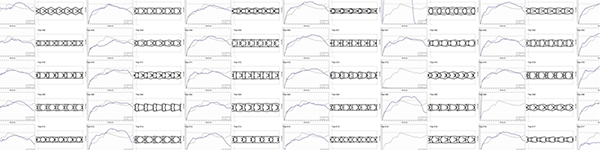
Before requirements are fully locked in, multiple proposals covering body structure, crash, NVH, thermal, and cost are verified in 3D to identify the winning path at an early stage.

Generative Geometry, Generative Simulation, and Generative Awareness are connected to rapidly cycle from initial design generation to next-iteration proposals.

By reducing uncertainty in the early stages and suppressing rework in the latter half of development, we contribute to improvements in development lead time, cost, and decision-making speed.
In automotive platform development, crash safety is one of the heaviest verification loops.
Generative Engineering enables a large number of structural hypotheses to be 3D-verified at the initial stage, finding a "fundamentally sound" concept before moving to detailed development.
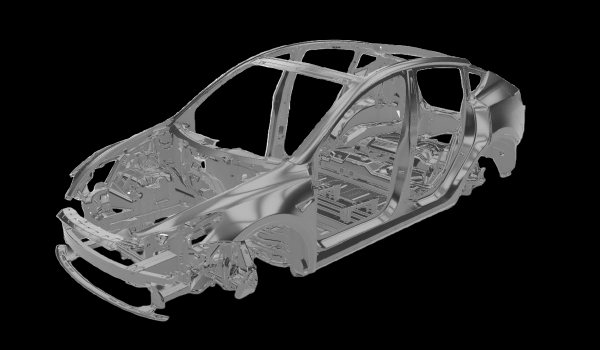
Crash safety design requires creating structural proposals, building CAE models, setting mesh and contact conditions, running analysis, interpreting results, and reflecting findings back into the design. Conventionally, verifying one proposal and reflecting it into the next iteration required at minimum two weeks.
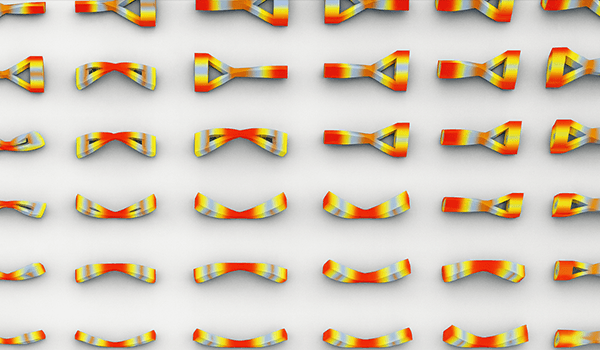
Generative Geometry generates structural candidates, Generative Simulation converts them into continuously analyzable models, and Generative Awareness interprets the analysis results. This targets a verification cycle of 10 proposals per day in the initial stages.
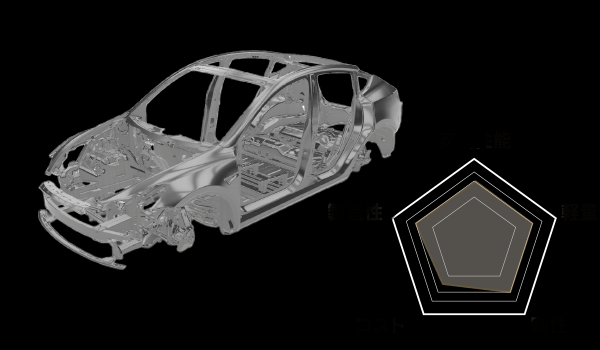
Rather than simply increasing the number of proposals, from the perspectives of load transfer, energy absorption, occupant protection, battery protection, weight reduction, and manufacturability, we identify structural concepts that will perform well in later stages.
From the earliest stages of platform development, Nature Architects accelerates the cycle of generating structural concepts, verifying them in 3D, interpreting results, and feeding them into the next iteration. By identifying "fundamentally sound" concepts from a large pool of candidates, we raise the confidence of decisions made before entering detailed development.
"Nature Architects dramatically accelerates the automotive development process. We transform design from 'a process that proceeds according to plan' into 'a process of learning toward the right answer.'"
What will be demanded in vehicle development going forward is not individual technical capability alone. The question is how quickly you can reach confident decisions amid the interplay of weight reduction, crash safety, NVH, thermal management, cost, and manufacturability. We shift development from plan-driven to learning-driven, creating a state where a vast design space can be explored, compared, and verified in a short time.