
Conventional Plan-Driven Development
Plan-driven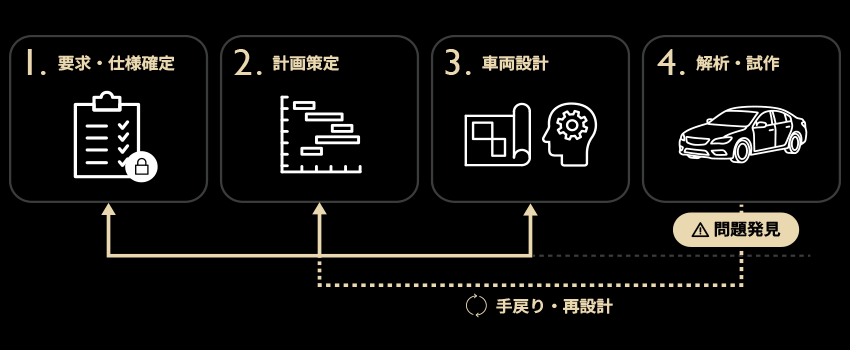
Because specifications are locked in upfront, problems tend to be discovered in later stages, leading to significant rework.









Generative Engineering is neither mere optimization nor mere analysis. It is a rapid loop that defines requirements, generates design proposals, verifies them through physics, interprets the results, and feeds them back into the next iteration. This page concisely presents that concept from the perspective of design processes spanning multiple industries.
The traditional approach meant fixing specifications first, then designing, and looping back when problems were discovered in later stages.
Generative Engineering generates design proposals before requirements are fully locked in, performs 3D verification on a digital twin, and feeds interpreted results into the next iteration.
By gathering sufficient decision-making data upstream, it identifies the winning path before moving to detailed development — raising both accuracy and speed across the entire development process.
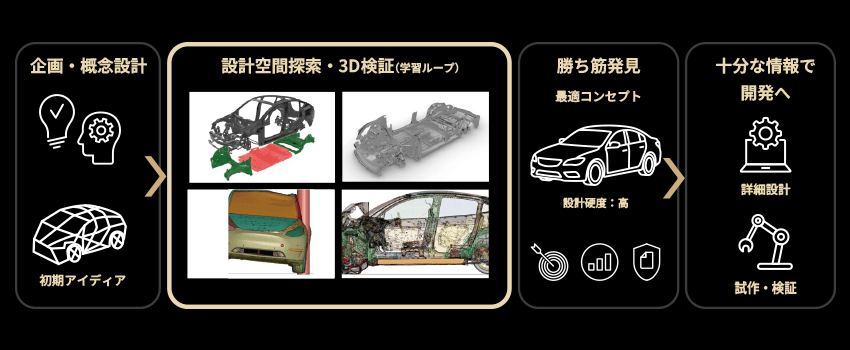
By broadly exploring the design space early in development and accumulating verifications on a digital twin, uncertainty is reduced faster — leading to more confident development decisions.
Accelerating the speed of design solution exploration and increasing verification density in the early stages of development.
By leveraging Generative Engineering as described below,
a cycle that previously evaluated one proposal every 10 days can be transformed into 10 proposals per day — a 100x increase in evaluation speed.
By rigorously validating strong concepts at the initial stage, weight reduction and cost savings of approximately 30–50% are achieved.
Furthermore, shortening the development period reduces labor costs, contributing to even greater cost savings.
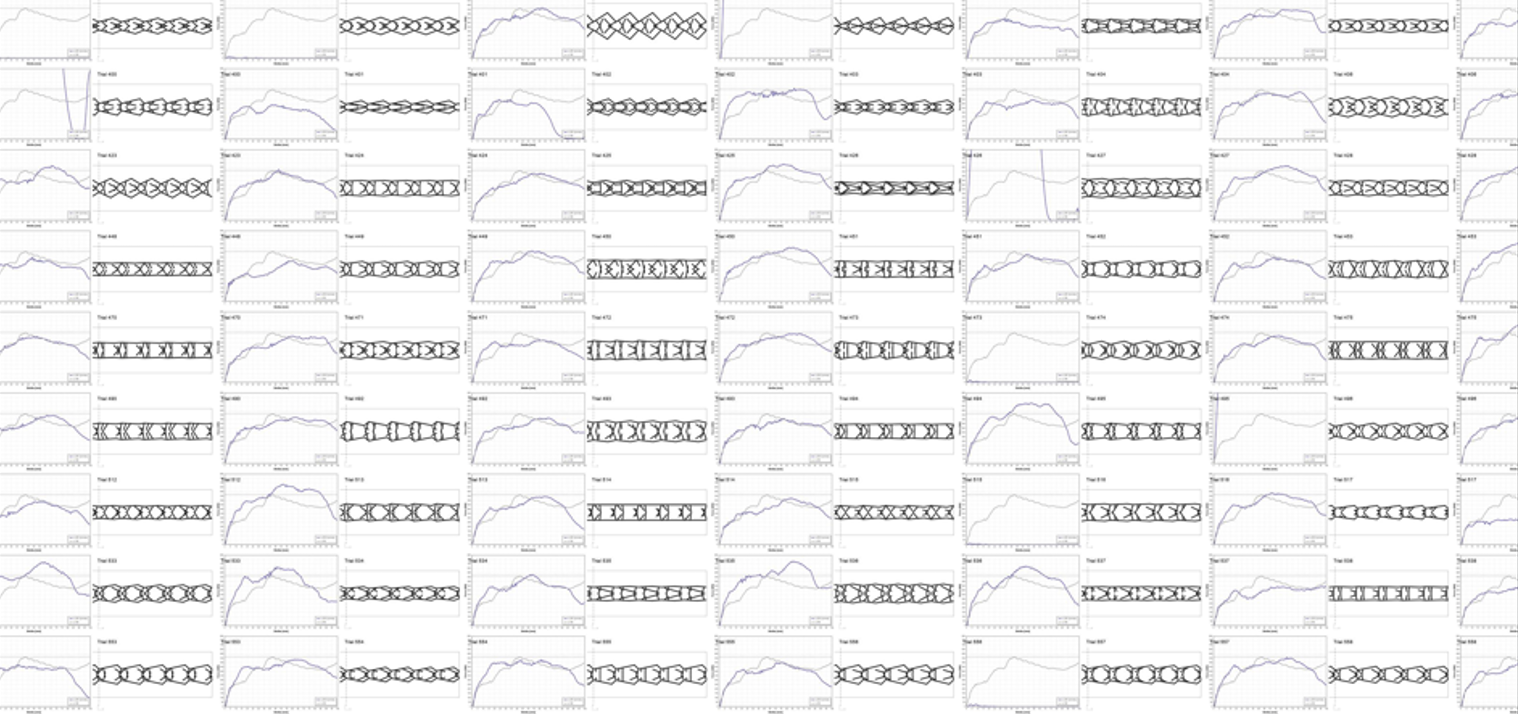
Generative Engineering is a proprietary platform that connects geometry generation, simulation model generation, and semantic interpretation of analysis results to dramatically accelerate the pace of evaluation in the early stages of development.
Generating a large number of candidate solution geometries.
Rather than crafting design proposals one by one from requirements and constraints, viable geometry candidates are generated at high speed.

Generating continuously executable simulation models.
Generated geometry candidates are converted into models ready for analysis, creating a state in which the verification loop can keep running without interruption.
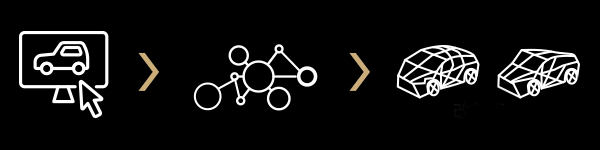
Extracting semantics from analysis results to generate the next design improvement proposals.
Rather than treating outputs as mere numerical results, the system interprets which structures were effective and where constraints lie, and connects those insights to the next design direction to explore.
By integrating all of the above, Generative Engineering connects requirement definition, design proposal generation, simulation, result interpretation, and next-iteration generation into a single high-speed loop. This enables ultra-fast development in which a large number of design hypotheses are 3D-verified upstream, and the winning path is identified before moving to detailed development.
For your product development challenges and initial concepts, we will help clarify which requirements to validate and which design spaces to explore, and work with you to assess feasibility.
Please feel free to reach out even if your requirements are not yet fully defined.
Contact Us Here →